Showing posts with label freemium. Show all posts

Wednesday, September 14, 2011

Freemium : $$$ v/s Time

Last week Flurry released an interesting chart on the Freemium games .


As evident, the data suggests that max amount of money (49%) is spent by users in the 25-34 age group. They play only for 29% of the relative time. One possible reason is that this demographic prefers to buy upgrades and special powers to help them cross levels faster. In the same light, the 18-24 years age group spends the max amount of time (32%) but only 16% of the relative revenue comes from them. This is even lower than than the 28% revenue coming from the 35-54 year age group which spends only 14% of the relative time.

While 13-24 year olds constitute more than 50% of the time spent, they contribute only 21% to the revenue. This is an interesting observations for gaming companies. It helps them understand that they can make more money by catering to the in-app purchases of this higher age group (24-54 years).

Flurry had earlier published that consumers spend an average of $14 per transaction when making in-app purchases in freemium games. What items does this money go to? Another interesting chart shows the spending on durable v/s consumable good.


Durable goods are those which can be use to provide permanent benefit in the game play and consumable provide only one time benefit. Personalized are those which are only for a purely decorative purpose. Consumable goods constitute more than 50% of all in-app purchased in freemium games. A majority of this is a towards game currency which can be used in multiple ways within the game.

The data cannot be generalized completely and should be taken with a pinch of salt. Depending on the actual game needs the attractiveness of the durable and goods will change.

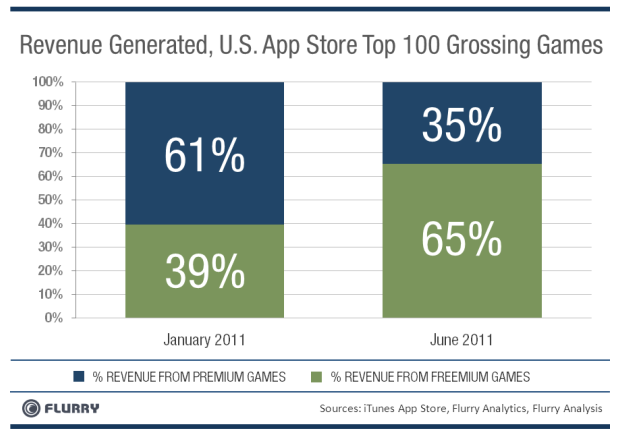
The two sets of analysis above are important when trying to decide what in-app purchases to offer and what age groups to cater to. With 65% of all revenue generated among the top 100 games now coming from freemium games these numbers become even more important to understand.

Tuesday, August 9, 2011

Mobile Gaming - The Freemium Way

A recent study by Flurry indicates that on an average iOS and Android Freemium Games generate $14 revenue using their Freemium model.


The rise of the Freemium mobile games has given some tough competition to Nindento DS and Sony PSP. an avid Freemium game player becomes so engaged in the game, that the usual $0.99 iPhone app threashold no longer bars him from a $9.99 purchase or in some cases even a $50 purchase (which is how much many of the game CDs for the PSP and DS sell for).


The Freemium model which has earlier been used by many big Web companies, as highlighted in my earlier post, is here to stay and rule the mobile gaming industry. It should come as no surpise that game drive 75% of revenue generated among the top 100 grossing iOS apps, of wihch 65% were generated from freemium games. Again, the crux of this model remains udnerstanding the customer segment and their needs to correctly decide the offerings in in-app purchase and price them right to induce purchase.


Monday, August 8, 2011

The 'Freemium' model

The "Freemium" business model for apps - in which apps offer some services for free, incentivizing users to try an app before paying for additional features is becoming more and more common in the top grossing apps on the various mobile app stores. The primary source of income for many freemium apps is in-app downloads.

A recent study by Flurry found that mobile phone games which are free to download, are actually making more money than those that charge.


Many companies let you download apps for free, rather than asking $0.99 to download a game you have never tried. when you become an passionate player, they you into paying quite a bit more than $0.99 for in-game virtual goodies like farm crops or power boosters. In June 2011, among the top 100 games in the iTunes store, free games generated almost twice as much revenue as games that charged to download.

The Freemium Business Model

The word “freemium” may be less than four years old, but the business model it describes – offering basic service access for free and then charging for advanced features – has been around for decades and is utilized by some of the Web’s most successful companies.

The working: Everyone gets your product or service for free, forever. But those customers who really like it, and find most value in it, will have a strong temptation to upgrade to a “premium” service which has lots of additional goodies and come at a price. It is a strategy for pricing by customer segmentation. It also requires a lot of insight into your customers and how they use your product to know what you want to giv for free to entice your user yet ensure you have some core features available for the paid versions.

Examples

Pandora - Since its launch in 2005, the company known for giving away “free” music to users has expanded to 20 million unique visitors. In 2009, it brought in $50 million in revenue – all the while as a freemium business

Skype- The popular internet calling service is free for those millions of customers who use it just to call or videochat between two computers anywhere in the world. Skype only charges if you want to use it to call a landline phone.

Some more examples include Flickr, Dropbox, Evernote, Spotify and recently announced Apple's iCloud music service.

With a high conversion rate and its ability to create an incredibly loyal audience, freemium has become a cornerstone of many successful startups and is definitely worth considering before you decide you pricing and go-to market strategy. But beware, not all Freemium products actually break even.